
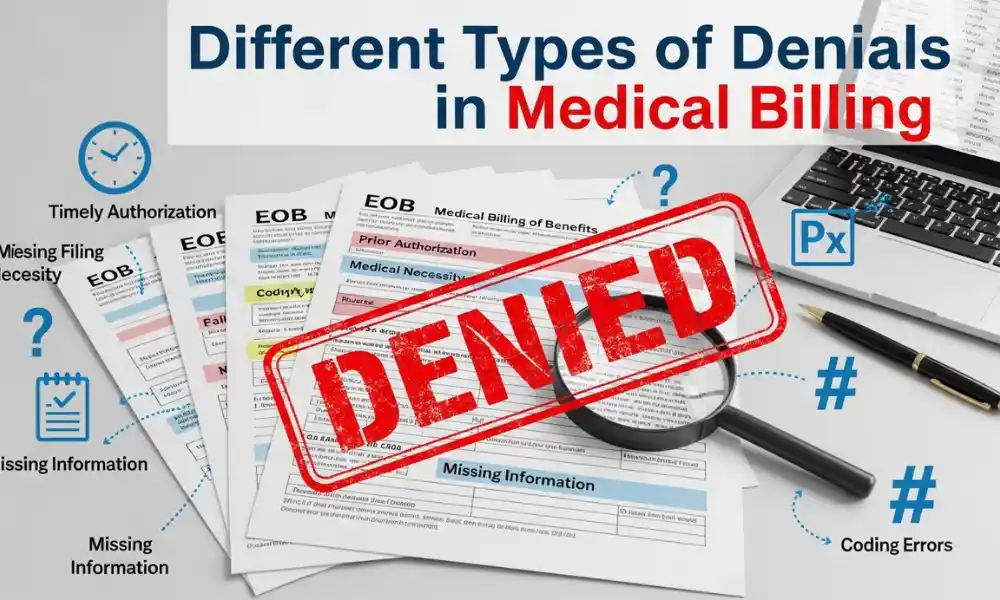

Medical billing denials are one of the biggest challenges healthcare providers face when managing their revenue cycle. Even when services are delivered correctly, claims can still be denied due to errors, missing documentation, or payer policy issues. Understanding the different types of denials in medical billing is essential for improving claim acceptance rates, reducing revenue loss, and strengthening overall financial performance.
This guide explains denial categories, common causes, prevention strategies, and best practices healthcare organizations can use to reduce claim rejections and improve reimbursement efficiency.
Understanding Medical Billing Denials
A denial occurs when an insurance company refuses to pay for a submitted healthcare claim. This can happen partially or completely depending on the issue identified by the payer.
Medical billing denials typically occur during the claims adjudication process, where insurance providers review claims based on eligibility, coding accuracy, medical necessity, and payer guidelines.
Denials directly impact Revenue Cycle Management (RCM) and can lead to increased accounts receivable (AR), delayed reimbursements, and higher administrative costs.
Difference Between Claim Rejections and Claim Denials
Before discussing denial types, it is important to understand the difference between claim rejections and denials.
Claim Rejections
Rejections occur before claims enter the payer’s processing system. These are usually caused by formatting errors or missing information. Rejected claims can typically be corrected and resubmitted quickly.
Claim Denials
Denials occur after the insurance company reviews the claim. These require appeals, additional documentation, or correction of coding or policy issues.
Understanding this distinction helps billing teams create faster correction workflows.
Why Do Medical Billing Denials Occur?
Denials usually happen because of issues related to:
- Patient eligibility verification
- Incorrect coding (CPT, ICD-10, HCPCS)
- Lack of medical necessity
- Authorization problems
- Duplicate billing
- Documentation errors
- Timely filing violations
Insurance companies such as Medicare, Medicaid, and private payers follow strict claim processing rules. Even small errors can lead to denied claims.
Major Types of Denials in Medical Billing
1. Eligibility and Coverage Denials
Eligibility denials occur when a patient’s insurance coverage is inactive, expired, or does not cover the provided service.
Common Causes:
- Patient insurance not verified before treatment
- Policy expired or inactive
- Service not included in patient benefits
- Incorrect insurance information
Prevention Strategies:
- Verify insurance eligibility before appointments
- Confirm coverage details and service limitations
- Collect updated insurance information from patients
Eligibility verification is one of the most important steps in denial prevention.
2. Authorization and Referral Denials
Some healthcare services require prior authorization or referrals from primary care providers. Failure to obtain approval often leads to denied claims.
Common Causes:
- Missing prior authorization
- Referral documentation not submitted
- Authorization expired
- Services performed before approval
Prevention Strategies:
- Implement automated authorization tracking
- Train staff to check referral requirements
- Verify payer authorization policies regularly
Authorization errors are among the most preventable denial types.
3. Coding and Billing Errors
Coding denials occur when incorrect CPT, ICD-10, or HCPCS codes are used. These errors often trigger claim rejections or payment reductions.
Common Causes:
- Incorrect diagnosis coding
- Mismatch between procedure and diagnosis
- Use of outdated codes
- Incorrect modifiers
- Unbundling or upcoding issues
Prevention Strategies:
- Conduct coding audits
- Provide ongoing coder training
- Use updated coding software
- Implement claim scrubbing tools
Accurate coding is critical for maximizing reimbursement and avoiding compliance risks.
4. Medical Necessity Denials
Insurance companies require documentation proving that treatments or procedures are medically necessary.
Common Causes:
- Insufficient clinical documentation
- Services not aligned with payer guidelines
- Lack of supporting medical records
- Experimental or non-covered treatments
Prevention Strategies:
- Maintain detailed patient records
- Align treatments with payer medical policies
- Train providers on documentation requirements
Medical necessity denials are common but can often be overturned through appeals.
5. Duplicate Claim Denials
Duplicate billing occurs when the same claim is submitted more than once for identical services.
Common Causes:
- Resubmitting claims without checking status
- Billing software duplication errors
- Multiple providers submitting similar claims
Prevention Strategies:
- Track claim submission history
- Confirm claim status before resubmission
- Use clearinghouse validation tools
Duplicate claims can lead to unnecessary payment delays.
6. Timely Filing Denials
Insurance companies require claims to be submitted within specific deadlines.
Common Causes:
- Late claim submission
- Delayed documentation from providers
- Billing workflow inefficiencies
Prevention Strategies:
- Establish claim submission timelines
- Monitor payer filing deadlines
- Automate billing alerts and reminders
Timely filing compliance is essential for maintaining revenue consistency.
7. Coordination of Benefits (COB) Denials
COB denials occur when multiple insurance policies exist and payment responsibility is unclear.
Common Causes:
- Incorrect primary and secondary insurance order
- Missing COB documentation
- Outdated patient insurance details
Prevention Strategies:
- Verify insurance coordination during patient registration
- Confirm primary and secondary coverage
- Update patient records regularly
COB issues often require patient communication and payer coordination.
8. Non-Covered Service Denials
These denials occur when insurance policies do not cover certain services or procedures.
Common Causes:
- Cosmetic or elective treatments
- Services excluded from payer plans
- Policy limitations
Prevention Strategies:
- Verify coverage before treatment
- Inform patients about out-of-pocket costs
- Offer self-pay options
Clear communication helps reduce patient dissatisfaction.
9. Documentation and Data Entry Errors
Incomplete or incorrect documentation often leads to claim denials.
Common Causes:
- Missing provider signatures
- Incorrect patient demographics
- Incomplete treatment notes
- Data entry mistakes
Prevention Strategies:
- Implement documentation checklists
- Train front-desk and clinical staff
- Use electronic health record (EHR) validation tools
Strong documentation improves claim approval rates.
10. Bundling and Unbundling Denials
Bundling denials occur when services that should be billed together are submitted separately. Unbundling can be considered a compliance violation.
Prevention Strategies:
- Follow National Correct Coding Initiative (NCCI) guidelines
- Use correct billing combinations
- Conduct coding compliance audits
Impact of Denials on Revenue Cycle Management
Medical billing denials affect several areas of healthcare operations, including:
- Increased accounts receivable days
- Reduced cash flow
- Higher administrative workload
- Increased compliance risks
- Lower provider productivity
Reducing denial rates is one of the most effective ways to improve practice profitability.
Denial Management Process in Medical Billing
A structured denial management workflow includes:
Denial Identification
Analyze payer Explanation of Benefits (EOB) and denial codes.
Root Cause Analysis
Identify patterns in denied claims.
Claim Correction and Appeal
Submit corrected claims with supporting documentation.
Performance Monitoring
Track denial trends using billing analytics.
Best Practices to Reduce Medical Billing Denials
Healthcare providers can reduce denial rates by implementing proactive strategies.
Strengthen Front-End Processes
- Verify insurance eligibility
- Confirm patient demographic details
- Collect authorization approvals
Improve Coding Accuracy
- Conduct routine coding audits
- Provide coder training
- Use AI-driven claim scrubbing tools
Enhance Documentation Quality
- Standardize provider documentation templates
- Ensure complete clinical records
Monitor Key Performance Indicators (KPIs)
Important denial-related KPIs include:
- First-pass claim acceptance rate
- Denial rate percentage
- Days in accounts receivable
- Appeal success rate
Role of Technology in Denial Prevention
Modern medical billing software, EHR systems, and revenue cycle management platforms help reduce denials by:
- Automating eligibility verification
- Detecting coding errors
- Tracking authorization requirements
- Monitoring claim submission deadlines
Artificial intelligence and predictive analytics are increasingly helping practices identify denial risks before claim submission.
Frequently Asked Questions About Medical Billing Denials
What is the most common type of denial in medical billing?
Eligibility and coding errors are among the most frequent denial categories.
Can denied claims be appealed?
Yes. Many denied claims can be successfully overturned through proper documentation and appeal submission.
How can practices reduce denial rates?
By improving eligibility verification, coding accuracy, documentation quality, and claim submission workflows.
What is an acceptable denial rate?
Industry benchmarks typically suggest maintaining denial rates below 5 percent.
Future Trends in Denial Management
Healthcare billing is evolving with advancements in automation, predictive analytics, and payer integration. Practices that invest in advanced revenue cycle tools and staff training are better positioned to reduce denials and improve reimbursement timelines.
Final Thoughts
Medical billing denials are a major challenge in healthcare revenue cycle management, but they are often preventable. Understanding the different types of denials, including eligibility, authorization, coding, medical necessity, and documentation errors, allows healthcare providers to develop stronger billing processes.