
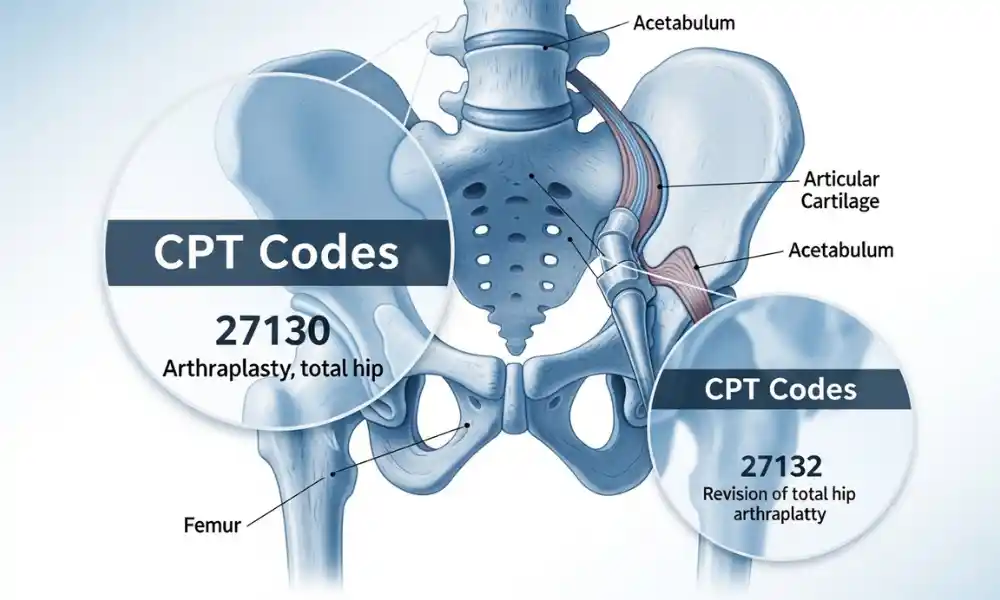

Total hip arthroplasty (THA), commonly known as total hip replacement surgery, is one of the most frequently performed orthopedic procedures in the United States. Due to its complexity, accurate CPT 27130 coding for total hip arthroplasty is critical for proper reimbursement, compliance, and denial prevention.
In this comprehensive guide, we will cover:
- The correct CPT codes for total hip arthroplasty
- Differences between primary and revision hip replacement codes
- Modifiers used in hip arthroplasty billing
- ICD-10 diagnosis pairing
- Global period and bundled services
- Common billing mistakes
- Documentation requirements
- Reimbursement considerations
This guide is ideal for orthopedic billers, medical coders, surgical practices, and revenue cycle management professionals.
What Is Total Hip Arthroplasty (THA)?
Total hip arthroplasty is a surgical procedure in which a damaged hip joint is replaced with prosthetic components. The procedure involves:
- Removal of the femoral head
- Placement of a prosthetic femoral stem
- Insertion of an acetabular cup
- Restoration of joint alignment and function
THA is typically performed to treat:
- Osteoarthritis
- Rheumatoid arthritis
- Avascular necrosis
- Post-traumatic arthritis
- Hip fractures
- Congenital hip deformities
Because of the complexity and cost of implants, accurate CPT coding is essential for proper surgical reimbursement.
Primary CPT Code for Total Hip Arthroplasty
CPT Code 27130 – Total Hip Arthroplasty
CPT 27130
Arthroplasty, acetabular and proximal femoral prosthetic replacement (total hip arthroplasty), with or without autograft or allograft.
This is the primary CPT code used for total hip replacement surgery.
What CPT 27130 Includes:
- Removal of femoral head
- Preparation of acetabulum
- Placement of prosthetic components
- Cemented or uncemented technique
- Bone grafting (if performed)
Bone grafting is bundled and should not be reported separately unless distinct circumstances apply.
CPT Codes for Revision Total Hip Arthroplasty
Revision procedures require different CPT codes depending on the component replaced.
CPT 27134
Revision of total hip arthroplasty; both components, with or without autograft/allograft.
CPT 27137
Revision of total hip arthroplasty; acetabular component only.
CPT 27138
Revision of total hip arthroplasty; femoral component only.
Correct component identification is critical for proper reimbursement.
CPT Code for Partial Hip Replacement
CPT 27125
Hemiarthroplasty (partial hip replacement).
This is typically used in hip fracture cases where only the femoral head is replaced.
Do not confuse hemiarthroplasty with total hip arthroplasty (27130).
CPT Coding for Hip Arthroplasty: Key Documentation Requirements
To support CPT 27130, the operative report must clearly document:
- Preoperative diagnosis
- Indication for surgery
- Approach used (posterior, lateral, anterior)
- Components implanted
- Fixation method (cemented vs uncemented)
- Any complications
- Estimated blood loss
- Implants used
Incomplete documentation can result in claim denials or downcoding.
ICD-10 Codes Commonly Paired with Total Hip Arthroplasty
Accurate ICD-10 diagnosis coding is essential for medical necessity.
Common ICD-10 codes include:
- M16.11 – Unilateral primary osteoarthritis, right hip
- M16.12 – Unilateral primary osteoarthritis, left hip
- M16.0 – Bilateral primary osteoarthritis of hip
- M87.051 – Avascular necrosis, right hip
- S72.001A – Fracture of unspecified part of neck of right femur
Ensure laterality (right, left, bilateral) is always documented.
Global Period for CPT 27130
Total hip arthroplasty has a:
90-day global period
This means postoperative visits related to the surgery are included in the reimbursement.
Bundled services include:
- Routine postoperative visits
- Suture removal
- Postoperative pain management
- Minor complications
Separate billing during the global period requires appropriate modifiers.
Important Modifiers for Hip Arthroplasty Billing
Modifier 50 – Bilateral Procedure
Used when both hips are replaced during the same session (if payer allows).
Modifier LT / RT
Indicates left or right side when required by payer.
Modifier 22 – Increased Procedural Services
Used when surgery required significantly more work than usual (documentation required).
Modifier 59
Used when distinct procedures are performed and not bundled.
Modifier 78
Used for return to operating room during global period.
Improper modifier usage is a major cause of orthopedic claim denials.
Bundled Services in Total Hip Arthroplasty
Under NCCI edits, several services are bundled with CPT 27130:
- Surgical exposure
- Closure
- Local anesthesia
- Fluoroscopy (in many cases)
- Bone grafting
Always check NCCI guidelines before reporting additional CPT codes.
Medicare Reimbursement for CPT 27130
Reimbursement varies by geographic location and facility type.
Factors affecting reimbursement:
- Inpatient vs outpatient setting
- Hospital vs ambulatory surgical center (ASC)
- Physician fee schedule
- Medicare Advantage contracts
- Commercial payer policies
Because THA is a high-cost procedure, correct coding significantly impacts practice revenue.
Outpatient vs Inpatient Hip Replacement Coding
CMS has increasingly shifted total hip arthroplasty to outpatient settings.
When performed outpatient:
- Payment may fall under APC system
- Documentation must justify medical necessity
- Hospital coding differs from physician coding
Practices must ensure alignment between facility and professional billing.
Common CPT Coding Mistakes in Total Hip Arthroplasty
- Reporting hemiarthroplasty instead of total hip arthroplasty
- Incorrect revision code selection
- Failing to document laterality
- Missing modifier usage
- Unbundling included services
- Incorrect global period billing
- Inadequate operative report details
These mistakes lead to denials, audits, and revenue loss.
Preauthorization Requirements
Most commercial insurers require preauthorization for total hip arthroplasty.
Failure to obtain authorization may result in:
- Claim denial
- Patient financial liability
- Revenue loss
Always verify benefits and authorization before surgery.
Medical Necessity for Total Hip Arthroplasty
Insurance payers require documentation showing:
- Failed conservative treatment
- Severe functional limitation
- Radiographic evidence of joint degeneration
- Pain interfering with daily activities
Clear documentation strengthens claim approval.
CPT Coding for Hip Arthroplasty Complications
Common complications requiring additional coding:
- Prosthetic joint infection
- Periprosthetic fracture
- Dislocation of hip prosthesis
These may require revision codes (27134, 27137, 27138).
Proper diagnosis coding is critical in these scenarios.
Revenue Cycle Considerations for Orthopedic Practices
Because total hip arthroplasty is high-value surgery, RCM accuracy is critical.
Best practices include:
- Pre-surgical insurance verification
- Accurate CPT and ICD-10 pairing
- Charge capture review
- Postoperative documentation audit
- Denial management follow-up
Even small coding errors can significantly affect revenue.
Frequently Asked Questions (FAQs)
1. What is the CPT code for total hip arthroplasty?
The primary CPT code is 27130 for total hip replacement surgery.
2. What is the difference between CPT 27130 and 27125?
CPT 27130 is for total hip arthroplasty, while 27125 is for hemiarthroplasty (partial hip replacement).
3. What is the global period for total hip arthroplasty?
The procedure carries a 90-day global period.
4. Can bone grafting be billed separately with 27130?
Typically no. Bone grafting is included unless performed under distinct circumstances.
5. How do you code bilateral hip replacement?
Use modifier 50 or payer-specific bilateral coding guidelines.
Final Thoughts
Accurate CPT coding for total hip arthroplasty is essential for:
- Maximizing reimbursement
- Avoiding denials
- Maintaining compliance
- Supporting orthopedic revenue cycle performance
CPT 27130 is the cornerstone code for primary total hip replacement, while revision procedures require precise component-based coding.
For healthcare providers aiming to streamline their billing processes and improve financial outcomes, BillingCare Pro offers top-tier medical billing services, helping practices stay compliant, reduce errors, and achieve optimal reimbursement with confidence.